

Gender Equality, SDGs
CARTIER WOMEN'S PAVILION AT THE 2025 WORLD EXPO
Raising awareness of gender equality to millions of visitors in Osaka, Japan


Clients: Project Everyone & Cartier
Challenge: Through their Women's Pavilion at the 2025 World Expo in Osaka, Cartier wanted to do something genuinely difficult: translate the state of gender equality in Japan and the world into an experience that would resonate emotionally with millions of visitors from vastly different cultural backgrounds, without losing the rigour of the underlying data.
Approach: I was brought in to source, structure and present the policy data that would sit alongside the Pavilion's creative experience, designed by multi-award winning artist Es Devlin. The goal was to make complex data feel accessible and engaging across three immersive chambers.
This involved:
-
developing pictograms from the World Economic Forum's Gender Gap Report showing how Japan compares to other countries on gender equality
-
building a timeline of women's achievements since 2020, from Pakistan's first female Supreme Court Justice to the first woman assigned to a lunar mission;
-
curating a continuous data ticker on the status of women, mapped to all 17 Sustainable Development Goals (SDGs);
-
and creating a gender equality quiz, drawn from UN Women's Gender Snapshot, for visitors to take at the end of their visit.
The key was balancing realism and optimism in order to keep visitors engaged, curating a celebration of women and their strengths mixed in with a recognition of the challenges they still face.
Outcome: The Pavilion reached up to 25.6 million World Expo visitors, offering one of the largest-scale public engagements on gender equality data in recent years. It received coverage from global news outlets, including Architectural Digest, the Financial Times, Forbes, Harper's Bazaar, Tatler and Elle.

Sport, Gender Equality, LGBTQIA+, Fossil Fuels
OPEN LETTER TO FIFA
A coalition of female footballers call for an end to FIFA's sponsorship deal with Saudi Aramco


Client: Athletes of the World
Challenge: In April 2024, FIFA signed a four-year global sponsorship deal with Saudi Aramco, the world's largest oil and gas company, covering both the 2026 men's and 2027 women's World Cups. The deal drew immediate backlash: Saudi Arabia's human rights record, particularly on gender equality and LGBTQ+ rights, sat in direct contradiction with the values of women's football.
For female players, the stakes were personal. FIFA had handed a major platform to a company whose parent state actively restricts the rights of the athletes it was now sponsoring. The window to push back was narrow, and the campaign needed to move fast.
Approach: A coalition of prominent female players, led by Sofie Jungen Pedersen, Tessel Middag and Katie Rood, came together to sign an open letter urging FIFA President Gianni Infantino to sever ties with Saudi Aramco.
I was brought in to design and execute the campaign strategy from the ground up. This began with a full concept note covering objectives, target audience, messaging, timeline, and call to action. From there I built out the full execution: a social media toolkit, Instagram graphics for the Athletes of the World page, a video edit sent to footballers calling on them to sign, a media briefing document for athletes doing press interviews, and a campaign webpage.
Outcome: 135 professional female players from 27 countries with over 2,700 caps between them signed the letter. It received global coverage from over 150 outlets, including ABC, the BBC, El País, the Huffington Post, CNN, l’Équipe, La Repubblica and Vanity Fair.

Finance, Climate Change, SDGs
#FREETHEFUNDS CAMPAIGN
A global campaign to reform the international financial system


Clients: Project Everyone, Open Society Foundations & Rockefeller Foundation
Challenge: In 2023, at the halfway mark to achieving the Sustainable Development Goals (SDGs), progress was stalling and in some areas reversing. Achieving the SDGs requires mobilising $4 trillion annually, yet the global financial institutions best placed to raise those funds, the World Bank and the IMF, are no longer fit for purpose.
The campaign called for widespread reform of these institutions, mobilising audiences across key G20 countries to show public support.
Approach: Since financial reform is one of the most technically complex issues in global development, making it feel accessible and relevant to a general audience required sustained strategic effort over 18 months.
During that time, I engaged closely with leaders in financial reform to track policy shifts in real time and ensure our messaging remained accurate, as the landscape rapidly evolved. To translate the latest thinking into clear insights I wrote blogs, briefing materials and a technical report for policymakers . I also contributed to the development of scripts and helped organize high-level dinners with key financial decision-makers, including President of the World Bank Ajay Banga, and economists Mariana Mazzucato and Lord Nicholas Stern.
In parallel, I worked with the creative team to test a wide range of content formats, from comics to vox pops, working with eight creators across the UK, US, India and Ukraine. The goal throughout was to identify different entry points into the issue and break down its complexity into bite-sized topics.
Outcome: Our content received over 5 million views across Instagram and TikTok. The campaign launched publicly with the Listen to Mia film on Sky News, championing Prime Minister of Barbados and financial reform advocate Mia Mottley, supported by a press release that generated 900 pieces of coverage.
Creative assets featuring World Bank President Ajay Banga were placed on billboards around Marrakech during the World Bank and IMF Annual Meetings, reaching all attendees directly. Our collaboration with content creator Max Klymenko alone generated over 4 million views, with his Guess The Business interview with World Bank Director Dirk Reinermann reaching 2.1 million views and 3 million impressions.
Sport, Climate Change
DEAR FUTURE IOC PRESIDENT
Olympians come together to secure climate pledges from IOC presidential candidates


Client: Athletes of the World
Challenge: As the International Olympic Committee (IOC) prepared to elect its next President, a growing movement of Olympians was calling for urgent climate leadership. Climate change was is disrupting competition schedules, threatening athlete safety, and altering training conditions, yet athletes have no formal mechanism to make their concerns heard at the highest level of Olympic governance. The presidential election offered a window of opportunity to secure commitments from candidates before one of them took office.
Approach: I was brought in to design and execute the full campaign, from crafting the letter itself to building the strategy for its rollout. The letter called on presidential candidates to commit to four specific actions: cutting carbon emissions swiftly, championing sustainable practices in Host Cities, setting standards on high-polluting sponsorships, and using the IOC's platform to advocate for broader environmental action.
I developed supporting materials, including a fact sheet and talking points for signatories conducting media interviews, a campaign webpage, and an article published on Earth.org. I also created a strategic plan for an Athlete Committee designed to keep the dialogue with the IOC alive beyond the letter's publication.
Outcome: 450 Olympians representing more than 90 countries and over 50 sports signed the letter. It received coverage from publications including Reuters, Forbes and CBC. Most presidential candidates responded with commitments to uphold athletes’ demands, crucially including Kirsty Coventry, who was ultimately elected to be the new IOC president.

SDGs
THE UN SDG PAVILION
An interactive event space bringing SDG data to life during the UN General Assembly in New York City

Clients: Project Everyone & the UN Office for Partnerships
Challenge: At the 78th session of the United Nations General Assembly in New York, world leaders gathered at a critical moment for the SDGs. With progress stalling and the 2030 deadline approaching, the risk was that the Goals would fade from the agenda entirely. The task was to create a physical space on UN grounds that made the Goals feel tangible, urgent and grounded in real data and people, rather than abstract political commitments
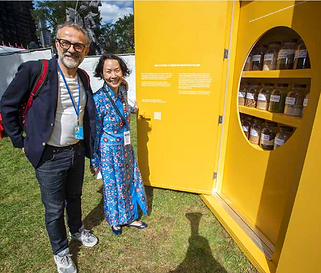
Approach: Working with multi-award winning artist Es Devlin, we created the SDG Pavilion, a versatile, semi-permanent structure which acted both as a venue on the inside and an art installation on the outside. The exterior featured 17 doors, each opening to reveal an art installation representing a different Goal. I was brought in to ground each installation in policy and data, giving visitors a clear picture of where progress stood and what solutions exist.
This involved working with the UN and Google Data Commons to source and select the right data points for each Goal, then wordsmithing each cabinet description to be concise, jargon-free and engaging. I also collaborated with Bloomberg Connects to build a museum-style digital experience - by scanning QR codes visitors could access detailed presentations on each door, art piece and SDG progress. The exhibition was also made available to the general public via Google Arts & Culture.
Outcome: Over 2,100 high-level attendees engaged directly with clear, data-grounded insights on SDG progress and actionable solutions. The Pavilion drew an exceptional line-up of speakers, including Prime Minister Mia Mottley of Barbados, UN Deputy Secretary General Amina Mohammed, and creatives including Orlando Bloom, Forest Whitaker, and Lily Singh. High-profile visits included UN Secretary General António Guterres, Former PM Justin Trudeau, and Mayor of London Sadiq Khan.

Climate Change, Global South
CLIMATE JUSTICE: WHO
HAS A SEAT AT THE TABLE
Equipping a grassroots organization with the tools, frameworks and network to influence climate policy


Client: Level the Playing Field in Development (LPF Dev)
Challenge: LPF Dev is a Kenyan organisation conducting research to expose the persistent gaps in participation and influence between the Global North and Global South at major climate events like COP. The problem wasn't the quality of the research, but rather that the research wasn’t reaching anyone beyond their website. Without the tools, relationships or strategy to get their findings in front of decision-makers, LPF Dev's work risked remaining an academic exercise rather than a driver of change.
Approach: I was brought in to build the infrastructure that would take LPF Dev from a research organisation to a policy influencer. This started with stakeholder mapping across Africa and other Global South regions, identifying the organisations and individuals best positioned to amplify and act on LPF Dev's findings. From there, I turned their flagship report into a suite of advocacy materials (policy briefs, talking points and external summaries) designed to be used directly by partners in their own advocacy work. I also built a light-touch impact framework to track partnerships, resource uptake and advocacy influence.
Outcome: By the end of the project, LPF Dev had published the advocacy materials, initiated outreach to the identified organizations, and brought printed briefs to in-person events, showcasing their work to prospective partners. The foundation for sustained advocacy influence is now in place.